
By Heidi Gibbs
I recently joined Innovation for Agriculture, taking the leap from education and agricultural engagement for young people to directly supporting farmer to farmer knowledge sharing. I strongly believe that agricultural education for all matters because as they are the consumers of the future, in order for them to make informed decisions they need to have the opportunity to see and understand the countryside and farming.
What do children know about agriculture?
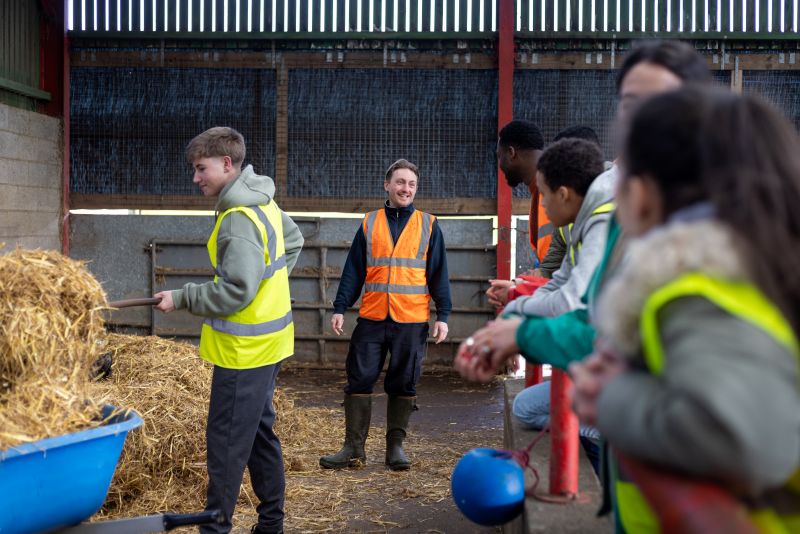
Agricultural literacy among young people remains critically low. It is common for visiting children to have never seen a farm animal in person. If they have, their exposure is often limited to commercial petting farms.
While petting farms serve a role in basic animal interaction, there is a distinct necessity to showcase real, operational working farms. This distinction allows children to build a genuine understanding of:
- Where food comes from: Disconnecting food products from neat supermarket packaging.
- How food is produced: Understanding the seasonal cycles, labour, animal welfare, and land management involved in sustainable food production.
Why is on-farm learning necessary?
In primary and secondary education, a foundational goal is to nurture inquisitive minds, encouraging children to revel in a sense of awe and wonder about the world around them.
Unfortunately, this natural curiosity often feels hindered or stifled when it comes to agriculture. Food and farming are frequently treated as abstract topics, separated from the living ecosystems that sustain us. Experiential, on-farm learning dismantles these barriers:
- Sensory Engagement: Watching real machinery, touching live soil, and interacting with animals transforms passive learning into active, unforgettable experiences.
- Inquiry-Driven Learning: Seeing a working farm naturally triggers questions about science, technology, ethics, and nature, reigniting that essential sense of wonder.
- Informed Future Citizens: Re-engaging children with the reality of farming ensures they grow up to be informed consumers, voters, and potential future leaders in agriculture and environmental stewardship.
The adult knowledge gap
My MSc research also revealed the gap in agricultural literacy is not limited to children—it extends equally to teachers, accompanying adults, and broader community groups.
To build a resilient food culture, educational outreach must target multiple demographics through systemic changes:
- Curriculum Integration: A larger, continuous portion of the national curriculum should be dedicated to agriculture, food systems, and land management—weaving these themes consistently across all key stages rather than treating them as one-off topics.
- Adult & Tertiary Education Outreach: Expanding government-funded farm visits and workshops to adults (aged 18+) creates a powerful ripple effect. Reaching university students and apprentices, particularly those training to become educators. In order to equip the next generation of teachers with firsthand knowledge before they step into the classroom.
- Community Engagement: Providing opportunities for diverse adult and community groups to engage with working farms fosters broader public appreciation, encourages constructive dialogue around land use, and builds trust between consumers and producers.
Although I’m no longer directly working in agricultural education, I see how the disconnect is contributing towards challenges faced by farmers such as market volatility and changes in trade deals. If the consumers of the future don’t understand agriculture, they are not going to understand the importance of our island’s self-sufficiency and buying British produce.
About Heidi Gibbs
Over the past six years, Heidi worked as a freelancer with The Country Trust, facilitating impactful, educational on-farm visits for disadvantaged children. Complementing this, she spent four years planning and hosting similar farm visits on her family’s working farm.
Heidi gained a MSc in Sustainable Food and Natural Resources in 2025, where her thesis investigated the direct impact of on-farm educational visits on agricultural literacy.
She is now based at Innovation for Agriculture as our delivery assistant manager.