
By Megan Dunn, soils and natural resources assistant at Innovation for Agriculture
This blog includes three exercises which can be carried out to start taking a systems-like approach to problem solving. I did not create these, but have found them useful in taking step back from linear decision making and seeing where connections can be made that had previously been ignored.
Tool 1: Inputs and outputs

This is a simple exercise to bring all of the elements (and potentially functions where necessary) of the farm system into one place. Thinking about the farm, write all of the inputs going into it on the left (this could be physical, financial, material, personal, spiritual, environmental…) and then everything that comes out of the farm (whether directly or indirectly produced) on the right. This should include all intended and unintended inputs and outputs (it can be more valuable to see the undesired elements written down as that can be an indicator of where decision making could be altered). At this stage it only needs to be individual words - although many of these connect together, there is no need to note this.
Tool two: The farm as a system

The next step is to think about how all of these elements connect with each other. It can help to do this over the top of a farm map or an image that shows different aspects of the farm to stimulate ideas about which areas connect to others, and potentially identify some feedback loops. It can be done just as well without an image, however.
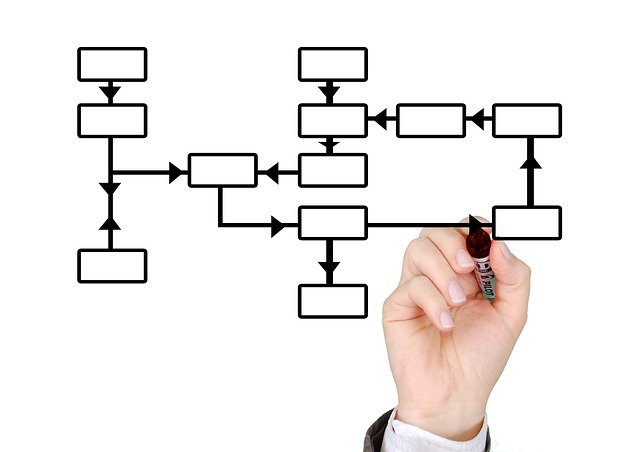
To start, label any elements or significant processes on the farm, then draw an arrow to anything that it contributes or connects to. The diagram above is not exhaustive of all the processes and interactions within a farm system, but it shows how one process can lead onto another and then another, identifying links that may have previously not been considered.
Once the first and second exercises have been completed, it should be easier to identify parts of the farm system that work well, and areas where it doesn’t. For example, do a lot of inputs go into producing only one output – could this be made more efficient? Is there one input that leads to many outputs – could this be replicated anywhere else? Does it look like there is an ‘end’ somewhere, or there’s something that doesn’t connect to other elements – could this be tied in somewhere to prevent waste? Do two operations run parallel to each other which could be joined up? Many questions could arise from these diagrams – which don’t all need to be answered immediately – but could start to stimulate ideas the next time changes are made on farm.
An in-depth focus on one system
In addition to thinking of the whole farm as a system, systems analysis can be carried out on one enterprise or element in detail. This can be a useful decision making tool when considering the role of existing enterprises on farm, and especially when considering adding a new enterprise to the business. The role of this is to go beyond thinking about the necessary inputs and outputs of an activity, but to also consider its wider impacts, such as on society and the environment.
To support decision making in a situation where there are multiple possible outcomes, it can be beneficial to create a diagram like this for each scenario, running through the path of all of the ‘what ifs’ to see how long term changes might play out.
For example, I was recently part of a discussion where it was suggested market gardens are currently a minor part of the food system in terms of kilograms of vegetables produced a year, and therefore should not be prioritised in agricultural discussions. When looked at through a systems lens, however, a market garden’s yields beyond vegetables, such as employment, outreach and education and connecting people to food production are vast, therefore they are a vital part of our food system. The ‘yield’ is far greater than Xkg of vegetables.
When decision making on a smaller scale this can also be useful, for example to assess whether integrating livestock into your farm system would be a worthwhile decision in the long run. These factors will ultimately vary between farm, but writing out these flow diagrams can help to see what the long-term impact of an action would be, once it became established.

Systems thinking on-farm
Initially, systems thinking can appear daunting, due to the added details that are brought into the process. However, approaching farm management decisions with a systems thinking lens can produce outcomes that are more resilient, more appropriate, and potentially lead to wide ranging benefits.
Find more detail on what systems thinking is and how it can be applied to farming systems here, or get in touch to share your experience of applying systems thinking to farming challenges.