
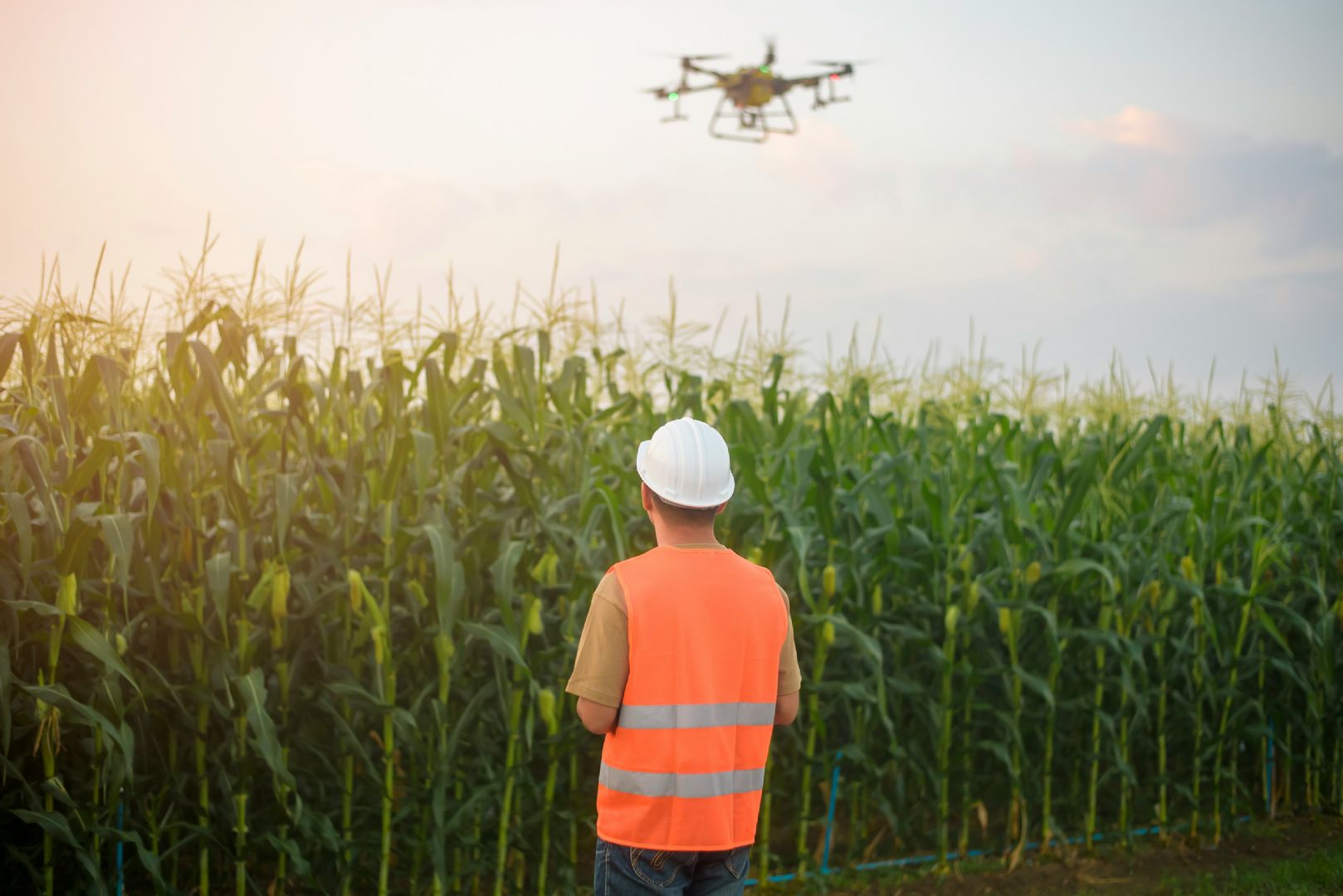
Unmanned Arial Vehicles (UAVs) – commonly called drones – have become a popular tool across many industries and enterprises. They have a wide range of uses due to their small size, relative accessibility, ability to reach tricky locations, and adaptability. In agriculture, they are becoming more widely used to carry out operations such as seeding and spraying, imaging and real time data collection. This blog explores how drones can be used in arable systems and particularly where they can be used to reduce the environmental impact of operations. It’s unlikely the drone will replace the tractor anytime soon, however their unique features could mean they become a more commonplace tool to support precision operations and decision making.
Using drones in the place of wheeled machinery
Currently, for arable systems, drones have three main operations: spreading fertiliser, plant protection products and seed. Market leading drones come with a tank capacity of up to 40l and can cover 30-50 acres in an hour. Within this hour the battery will need to be recharged and replaced a few times, however this is designed to be a quick and easy process which can take place from a practical, static location.
Drones can be used for precise applications of fertilisers, herbicides and fungicides, meaning that money isn’t wasted on spraying a whole field and there are fewer environmental risks. In developed crops they can be beneficial as they prevent damage from travelling through the field, for example when applying pod stick to oilseed rape. Many drones can spread liquid or granular fertiliser as well as biological products.
For seeding, drones offer flexible approaches to broadcasting companion and cover crops. They are not currently suited to all seeding requirements, however they can be a useful tool for overseeding tall, leafy crops while avoiding damage to the standing crop. Drones can also be used to get a quick cover crop on bare ground after harvest or for companion planting with species such as clover.
Imaging and monitoring with drones
There are a variety of ways crop health, pest pressures and landscape features can be monitored and assessed. Drones offer a detailed, accurate, real time interpretation of the land and vegetation, providing high quality data to inform decision making.
At a field scale drones can be used to assess plant establishment and growth rates, which can inform decision making around nitrogen use, preventing wasted fertiliser or an under-fed crop. More widely for crop health, thermal imaging can be used to detect pest pressures on the crop, and disease outbreaks or weed problems can be spotted by cameras monitoring the reflection of different wavelengths of light. Data gathered by drones can be analysed using algorithms which allows problems to be identified much earlier than they could be with a human eye. This data can then inform spot spraying or targeted nutrition.
Drones can be used to spot issues with soil compaction and drainage through assessing the crops NDVI (Normal Difference Vegetation Index). This effectively gives a score of the crop’s greenness, highlighting patches of stress through drought or waterlogging. More broadly across the farm, drones can be used to map a whole range of elements such as topography, or use 3D imaging to estimate above ground carbon storage in vegetation.
Using drones repeatedly over several years can build up a bank of images which highlight where there are repetitive problems or successes, which can support long-term future planning. Before using a drone it is worth considering what data is most valuable, as they can gather huge volumes of information which is worthless or potentially a burden if only a small part is needed.
Environmental benefits of drones
Due to their small size, reduced fuel consumption, precise approach and ability to fly over the land and crops, drones can have a reduced environmental impact compared to conventional tactors and sprayers.
One of their most notable benefits is their lack of contact with the soil. Using a drone completely avoids soil compaction, disturbance and erosion. Even if a drone only replaces some of the passes through a field, it will reduce the damage done to the soil, especially in a year of unfavourable conditions. Use of drones can also avoid wear and tear inflicted on machinery used in wet conditions and will reduce fuel use by avoiding the need to drive through heavy soils. Of course, the weather conditions have to be right for the drone to fly and products to work, however Farm Drones UK state that drones have an advantage 70% of the time over wheeled machinery across different weather conditions.
Using drones for seeding brings a suite of potential benefits by growing multiple species in one field, such as integrated pest management, support for pollinators, increased soil fertility and reduction in exposed soil.
Challenges of drones
As with all technologies, drones are not a one-size-fits-all solution. Flying a drone requires careful legal considerations to ensure it can fly when and where it is needed. A license must be obtained before flying a drone, with additional licences needed when spraying products. There are a number of companies now offering operations with drones, potentially making it easier to integrate them into the farm like a contractor, rather than a piece of equipment each farm will own.
A major restriction is their carrying capacity and battery life. This is improving over time, however, and their current size brings benefits such as being easy to transport in standard vehicles. One sticking point is that most drones need a generator in the field (requiring diesel or another fossil fuel) to recharge their batteries, so although the drone is electric, they still require fossil fuels.
The ongoing role of drones
Drones are continually becoming a more established piece of kit in British agriculture. They have a range of benefits from reducing input costs through targeted applications, to encouraging companion planting and greater in-field diversity. Their ability to gather data across a field or landscape could become an invaluable tool for planning, however the necessary hoops to jump through in terms of licencing and getting permission to fly cannot be underestimated and support from an established operator should be sought to prevent any issues. The small size of a drone, and need for frequent recharging can be a barrier, but as technology continues to develop these should be improved, and may be negated by the benefits a drone can bring to the farm system overall.
By Megan Dunn, soils and natural resources assistant at Innovation for Agriculture