
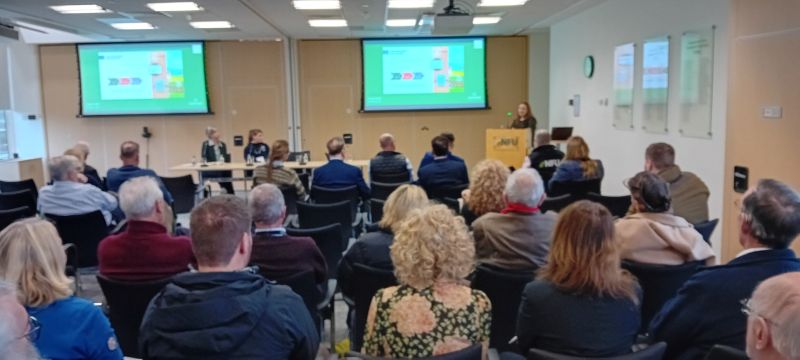
Innovation for Agriculture supported Warwickshire County Council, Warwickshire Rural Hub, the NFU and River Severn Partnership to host Growing Your Innovative Agri Resources earlier this month.
The event saw speakers Jake Freestone, Neave Anderson, Dr Megan Lewis and Dr Helen Ferrier discuss the role of technology and innovation in farm practices, as well as the importance of more low-tech solutions.
Trialling biodiversity monitoring technologies
One theme of the day was trialling technologies to see what works for you. Jake gave a clear example of the importance of heat detecting, night vision cameras when monitoring on farm biodiversity. Once it was dark, heat cameras were able to ‘see’ the activity of numerous skylarks in Jake’s fields. Skylarks are a red list species and can be much harder to record during the day, and Jake made the important point that if he hadn’t used the cameras he may not have known that there were so many skylarks on the farm. This comes back to the point that farming and nature can never be separated, and potentially there are many farms which are supporting species such as skylarks, however they are not given credit for this because they currently don’t have the technology to fully monitor biodiversity.
Impact of technology on farm routines
Neave Anderson, from Hartpury University, described their process of installing milking robots and how that changed their practices. Initially, Neave said, there was reluctancy from the staff to engage with the robots as they had always had a traditional parlour routine, however once the robots were up and running staff much preferred their days working on ‘robot duty’, rather than in the parlour, as it meant they didn’t have to start their day until nine o’clock, rather than six. Neave also outlined how this means their students are now able to be trained to use the robots, therefore they will enter the workforce with a different set of skills which could give them the edge when looking for jobs. There are many reasons why some are reluctant to installing robots, such as wanting to keep the parlour routine to allow them to carry out health checks and observe the herd thoroughly and regularly, however for Hartpury, it was clear that the work style the robots allowed improved the work/life balance of staff.
With increasing technological solutions entering the marketplace it offers more farms the opportunity and flexibility to chose what works best for them. Not all technology will be right for all farms, however having more options available, such as milking robots, could allow more farmers to make the job work for them, allowing greater autonomy and job satisfaction.
New monitoring technologies and data processing
Dr Megan Lewis shared insight into some of the technology that is being developed at Harper Adams to support farm practices and deliver other functions, such as monitoring biodiversity. There were several projects developing solutions to make biodiversity monitoring easier, less labour intensive and more accurate for farmers, which addressed Jake’s point and should enable farmers to know exactly what species they have on farm. This is important both so farmers can make informed choices about how they can potentially modify their practices to support these species without impacting their crop quality or yield, but it is also important evidence so all farmers can be acknowledged for the biodiversity they already support.
Processing the vast amounts of data from these pieces of tech was identified as a real challenge to adoption. Megan acknowledged that Harper Adams has a data analysis team with both the time and skills to look through all the data. This is something that would not be possible for many farmers simply because of the time it takes. This, alongside knowing how to make the most of the data once you have it and the ongoing issue that most software currently doesn’t ‘talk’ to each other, so data may be duplicated or have to be manually combined, was highlighted to be something that the industry needs support to overcome, so that technology can be accessible and useful for all farmers.
Industry wide collaboration
Dr Helen Ferrier spoke about the need for collaboration across the industry. She highlighted that no problems can be solved in isolation, especially the complex issues we are facing today that combine environmental, political and social challenges. The opportunities and barriers that the increased use of technology in agriculture presents show this clearly, as agriculture will need to learn from other industries that have already integrated technology into everyday practice and build on the work they have already done.
Technology does present opportunities to improve farming practice, however there are challenges and barriers that need to be overcome before many emerging solutions can be fully adopted. There can often be a feeling of reluctance around engaging with new technology, especially given the other demands that are currently being placed on the industry. Initially, it can seem that using more ‘nature friendly’ practices would be at odds with adopting more technology, however many of the talks at Growing Your Innovative Agri Resources showed that using the right pieces of technology carefully integrated into a farm business can enhance the farm’s ability to support nature, improve general practice and allow a more flexible work pattern.