
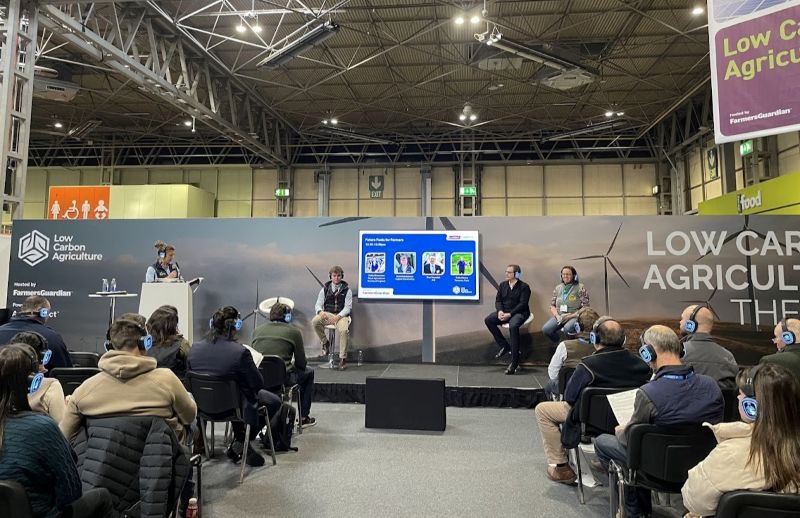
In January, we attended Low Carbon Agriculture, alongside LAMMA and CropTec, with our Farm of the Future project. In partnership with the event’s Innovation Trail, we were showcasing some of the upcoming ideas and themes in agriculture which may be seen on ‘the farm of the future’.
Holly Shearman, IfA’s head of livestock, chaired a panel on Future Fuels for Farmers with Katie Hoare, Tom Beamish and Josh Hutchinson, where the topic of how agriculture can feasibly move away from red diesel was discussed, highlighting examples that are already working for some farms, such as biomethane.
With hundreds of stalls next door exhibiting their newest, industry leading, innovative kit, it really raised the question of what the average farm may look like in 20, 50 or 100 years, and what steps need to be taken now in order to ensure that those farms in the future don’t face many of the challenges we do today.
A key topic of discussion was carbon. Being at the low carbon show this was not a surprise, and given the impacts we are seeing across the country from extreme weather, disease pressure and unpredictable seasons, happening as a result of climate change, carbon should definitely be at the top of our agendas. However, Olivia Midgely, Editorial Director at Farmer’s Guardian, chaired a panel titled ‘Seeing the Bigger Picture: Farming Beyond Carbon’. The panel held an honest discussion about the need to centre carbon in talks about the future of agriculture, however emphasised the problem of too much tunnel vision on the topic, and the risks this could pose for the wider food system in the future.
All speakers raised vital points about the need to also address biodiversity loss, water management, soil health, nutrient density and public engagement to create a truly sustainable food system. A number of examples were given to demonstrate where carbon may not be the number we really want to focus on, as so much will be missed from the one-sided picture. Clare Hill from Planton Farm proposed the risks of celebrating factory farmed, intensively produced chicken over pasture raised, organic beef, because the chicken has a lower carbon footprint. When looking from a nutrient density point of view, however, as well as the animal’s ability to support the creation of habitats or healthy soils for flood prevention, the chicken may not come out on top.
As the government and a vast number of organisations, including the NFU, pledge for Net-Zero targets, there sometimes feels like there is a race on to quantify the carbon footprint of everything and then reduce that number to be as small as possible. This is important as climate change threatens so many of the systems we rely on as humans, however this panel was a key reminder that this must not be the only metric we look at. One challenge is that we now have several carbon calculators which can easily be used to produce a farm’s carbon footprint (even if there are still some limitations to their processes) and this gives us a quantifiable position of the farm. Biodiversity, ecosystem health, social benefit, natural flood risk reduction and nutrient density are currently harder elements to quantify on farm, and therefore it is much easier for organisations and bodies to work with the figures they do have access to, which usually comes down to carbon.
Carbon footprinting can be an incredibly useful process for a farm, at Innovation for Agriculture we are producing farm carbon footprints almost every week, however their results cannot be taken as gospel or used in isolation.
A sustainable and resilient food system relies on the climate to be stable, but also for biodiversity and soil to be healthy, water systems to be in balance and for society to be able to support and be supported by it. Farms in the future will – and need to – have a lower carbon footprint than farms today, however this does not mean that carbon should be the metric to define a successful farm. The food system – and therefore farms – must holistically support all natural and social systems which means that some farms may never be completely carbon neutral, but if they are positively enabling other systems to remain healthy and resilient, maybe that will have an even greater impact.
By Megan Dunn, Soils and Natural Resources Assistant at Innovation for Agriculture