
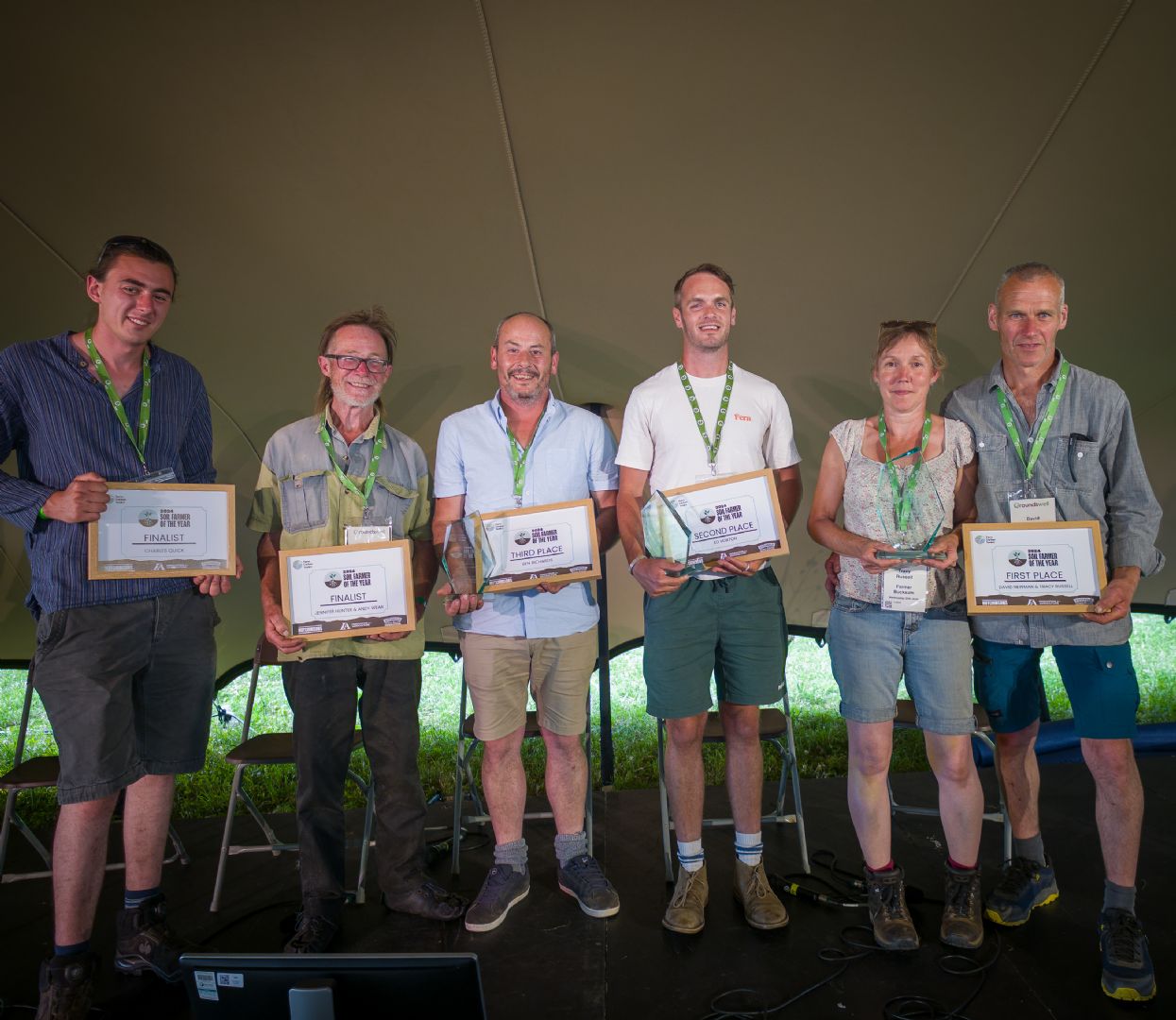
In recent years, biologically active, resilient soils have gained recognition as the foundation of profitable, sustainable farming. The Soil Farmer of the Year competition, jointly run by Innovation for Agriculture and the Farm Carbon Toolkit, celebrates farmers putting soil first. It is proudly supported by Hutchinsons and Cotswold Seeds.
This year’s finalists—Robert Whittal, Paul Baker, Will Oliver, Andrew Mahon, Jonathan Hodgson, and John Joseph—have each prioritised soil health through long-term thinking, openness to innovation, and decisions that support strong business performance.
You can hear directly from the winners at the Soil Farmer of the Year Awards Ceremony at Groundswell—taking place at 7pm on Wednesday 2nd July at Speakers’ Corner. For now, meet the finalists below:
Robert Whittal, Square Farm, Monmouthshire
Robert Whittal’s 190-acre organic mixed farm is a living example of how patient, observation-led farming can rebuild soil health and farm resilience—without chemicals or heavy cultivation.
Through rotational grazing with cattle, sheep, pigs and poultry, under-sown cereals, herbal leys, and companion cropping, Robert has created a diverse, integrated system on challenging clay/silt soils. In just five years, he’s seen improved water filtration, deeper rooting, better drought tolerance, and stronger livestock condition—without a single synthetic input.
Robert’s passion for learning and sharing is equally clear: he’s hosted oversubscribed farm walks, started making his own Johnson-Su compost, and is mentoring peers through the Marches convergence.
Will Oliver, AH Oliver and Son, Leicestershire
Paul Baker farms 600ha of clay loam and is steadily reshaping his business around soil resilience, data-led decisions, and practical regenerative principles.
Over the past five years, Paul has implemented no-till where appropriate, increased organic matter through strategic use of manures and grain maize, and overhauled drainage infrastructure with targeted mole ploughing. Soil sampling, spade diagnostics, and common-sense traffic management underpin his day-to-day decisions.
His results speak volumes: organic matter has risen from below 2% to over 6% on arable fields, crop margins have improved, and his 2024 cost of production for grain maize was just £48/t. In Paul’s words, the farm is “more resilient, more profitable—and more enjoyable to manage.”
Paul Baker, Wishay Farm, Devon
Will Oliver farms 340 acres of sand/clay loam in Leicestershire and is redefining what’s possible with soil management—on both organic and conventional land.
Over the past five years, Will has shifted from plough-based systems to strip tillage, cutting diesel use by up to 75% and reducing inputs with careful experimentation. He’s composting on-farm, trialling foliar feeds, using acidified water to reduce glyphosate volumes, and even exploring the use of fermented animal waste for amino acid fertilisation.
With rising organic matter, more worms, and regenerating grasslands via mob grazing, his soils are visibly improving—healthier, more biologically active, and holding moisture better. His most recent carbon audit reported a net-zero footprint, a remarkable outcome at this early stage of the journey.
Andrew Mahon, Glebe Farm, Bedfordshire
Andrew Mahon manages 800ha of Hanslope clay at Glebe Farm—and over the last decade, he has redefined how large-scale arable farming can work in harmony with soil biology.
Having moved from full cultivation to direct drilling in 2015, Andrew has built a resilient, biologically active system through cover cropping, straw retention, GPS-marked soil testing, and a near-total halt on P&K applications. Recently, he’s invested in Johnson-Su compost systems and an extractor to apply microbial extracts at drilling—targeting a shift toward fungal-dominated soils.
Even on heavy clay, the results are evident: increased organic matter (0.1–0.2% annually), improved traffic carrying capacity, rising worm populations, and reduced nutrient imbalances. One half of the farm alone sequestered 4,000 tonnes of carbon in a single season—verified and independently retested.
Jonathan Hodgson, Great Newsome Farm, East Yorkshire
Jonathan Hodgson farms 285ha of medium clay soils at Great Newsome Farm in East Yorkshire. Over the past five years, he has transformed the way his mixed farm interacts with its soil—prioritising biology, resilience, and long-term viability.
Following a bold decision in 2019 to sell almost all cultivation equipment, Jonathan embraced strip-till, herbal leys, and integrated livestock. He cut out artificial P&K, seed dressings, insecticides, and dramatically reduced fungicides and growth regulators. Today, his nitrogen is applied little and often, with molasses to support microbial health.
The results are tangible: better water filtration, richer soil structure, high worm counts—including all four worm species—and increasingly resilient, pest-resistant crops.
John Joseph, Trecorras Farm, Herefordshire
John Joseph, an arable farmer stewarding 100ha of sandy loam in Herefordshire, has spent over a decade reshaping how soils are understood and managed on his farm.
John’s approach pivots on three core principles: never cultivating the soil, always maintaining a living root, and combining every synthetic input with a carbon source. His system incorporates companion and catch crops, a strict no-insecticide policy, carbon-paired nitrogen application, and homemade compost from his Red Poll cattle enterprise—delivered with scientific precision, thanks to his on-farm horticultural nutritionist.
The result? Soil health has flourished. Aggregation has returned. Worms, beetles, and microbiology are thriving. Water retention has improved so significantly that runoff is now negligible, and crops remain productive even under prolonged drought. On this foundation, yields are up, input costs are down, and John’s farm now produces nutrient-rich seed crops with growing interest from the food industry.
What’s next?
The Soil Farmer of the Year Awards Ceremony takes place at 7pm on 2nd July at Groundswell (Speakers’ Corner)—don’t miss the chance to hear from the winners directly.
Later in the year, all finalists will host farm walks, offering a closer look at the systems and practices transforming their soils and businesses. Stay tuned via Innovation for Agriculture and Farm Carbon Toolkit channels for dates and registration.