
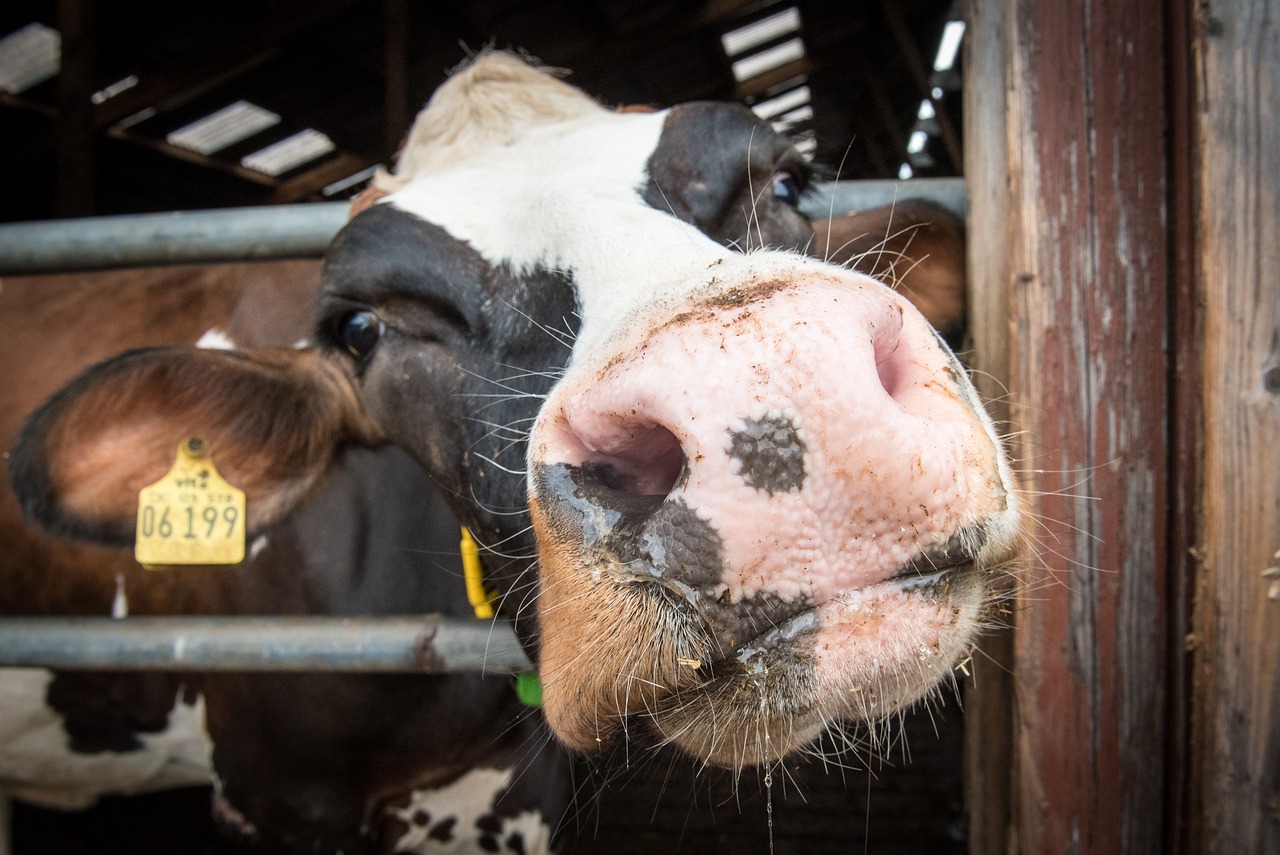
Enteric fermentation is responsible for approximately half of the greenhouse gas emissions associated with dairy milk production, making it an important source of emissions to address.
A recent Climate Farm Demo webinar hosted by Benoit Rouillé from the French Livestock Institute explored the approaches available to measure, predict and reduce methane emissions of dairy cows.
Measuring methane emissions
Speaking in the webinar, Benoit covered the five methods available to measure the methane emissions from dairy cows.
Respiratory chamber
A respiratory chamber can be used to measure emissions from one cow, by placing the cow in a chamber with controlled air fluxes. To calculate the methane emitted by the cow, in g/day, it is essential to know both the concentration of methane and the air fluxes in the chamber.
Use of respiratory chambers is expensive and time demanding, and it is not possible to put many animals into these structures, limiting its usefulness for measuring emissions at herd scale.
Gas collection harness
Gas collection harnesses are positioned on the back of a cow, and a sulphur hexafluoride (SF6) bolus is put into the rumen.
The technique works on the basis that CH4 and SF6 from the rumen have identical dispersion characteristics in the animal, and therefore have an identical probability of interception by a ‘breath’ sampler located near the nose.
The release rate of SF6 from the bolus is known, and so the ratio of CH4 and SF6 gases captured in the breath sample and stored in the harness can be used to calculate the daily CH4 emissions from the cow.
The gas collection harness method was developed to measure emissions while cows are grazing, but it is expensive, easy to break and is difficult to use in real farm situations.
GreenFeed (C-lock) feeders
GreenFeed (C-lock) feeders are automatic feeders coupled with gas analysers and sensors which can be used to measure methane concentration and air fluxes. If there are enough visits from a cow per day, models can be used to estimate the emissions in g/day. This is the most used method for scientific purposes and tests on farms.
Spot measures of methane emissions
In addition to the methods above, which measure and calculate methane emissions in g/day, it is also possible to carry out spot measures of methane emissions (in ppm) of eructed air from cows.
For example, a laser methane detector can be used to measure methane live at the nose of the animal, with a measurement lasting between three and four minutes. This provides a reliable measurement of the methane being emitted by that cow at that time, but does not take into account the fluctuations in emissions throughout the day.
Laser methane detectors require an operator and are therefore time demanding as a technique. Another option is a sniffer in a milking robot or automatic feeder. With these, each time a cow comes for eating or milking the detector can register the concentration of different gases in their breath, including CH4, CO2 and sometimes water vapour.
Predicting methane emissions
Measuring methane emitted from dairy cows is time demanding, expensive and limited in terms of being able to account for differences between the cows in a herd.
An alternative option is to use an equation to predict the methane emissions from a cow. Speaking in the webinar, Benoit highlighted three methods that can be used to predict methane emissions from dairy cows.
- Diet and intake data can be used in an equation to estimate the methane emissions of the dairy cow in g/kg of dry organic matter. This is a generic equation, and it is difficult to account for diet diversity over a year, or between different systems or different climatic zones.
- The fatty acid profile in the milk can be used as a proxy to predict the methane emissions in g / kg milk. There are different equations available to predict methane emissions based on fatty acid profiles.
- A mid-infrared (MIR) milk spectra can be used with an equation to predict the methane emissions in g / kg milk.
There are a lot of levers available to reduce methane emissions from dairy cows, but understanding the emissions from a herd, either via measurement or prediction, is an essential first step to knowing the impact of any adjustments made. Find out more about approaches to reduce methane emissions from dairy production here or watch the Climate Farm Demo webinar on measuring, predicting and reducing enteric methane emissions of dairy cows here.