
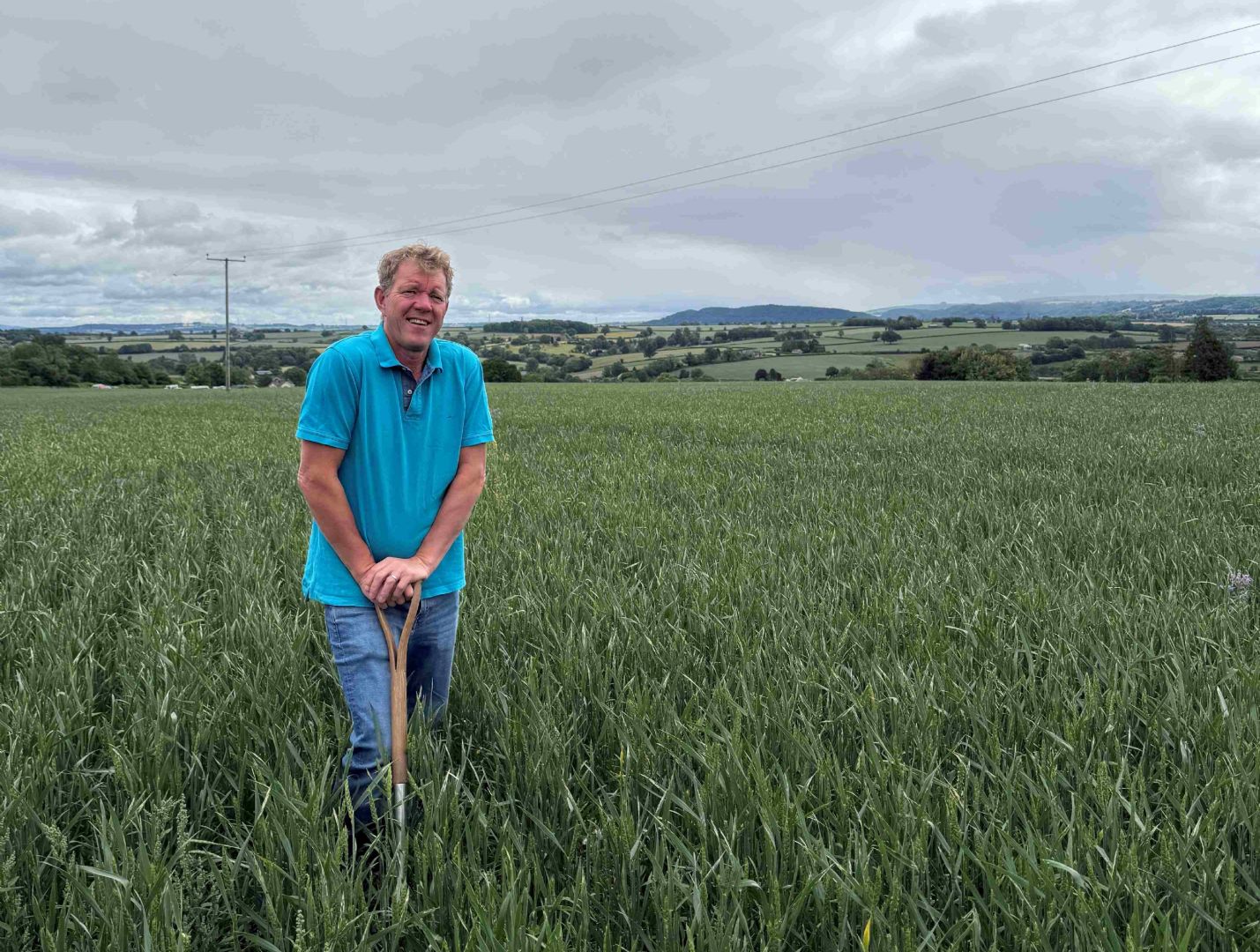
John Joseph from Trecorras Farm in Herefordshire was the overall winner of the 2025 Soil Farmer of the Year competition. Farming a 220-acre farm on the edge of the Wye Valley, John and his wife Julie have redesigned their system based on the principle that profitable farming starts with healthy soil.
Over the past 15 years, they have widened rotations, reduced cultivations, introduced herbal leys, integrated rotationally grazed livestock, and focused on growing higher-value seed. More recently, they have introduced Wildfarmed bread wheat into the rotation, adding diversity into their markets as seed prices have waned. Today the business combines regenerative principles with commercial pragmatism, producing resilient crops while steadily reducing inputs.
Prioritising soil as part of farm economics
Soil has featured in farm management decisions since the Josephs arrived at Trecorras Farm. Being 70% sandy loam over Herefordshire clay, and high in magnesium, the soil across the farm is prone is to both compaction and erosion. When they arrived on the farm, the soil had poor structure and little biological activity. In their second year, a particularly wet season washed soil into the nearby village so severely that residents were picking potatoes up outside their homes.
“I was very aware that our soils were suffering from the effects of over cultivation,” says John. “We had to find a way to get off the treadmill of more inputs for the same or declining results.”
The state of their soil when they arrived, along with the necessity to make the farm business work economically, set John onto the course to get a fully functioning ecological soil system.
“I realised I was going to need to reduce our use of fertilisers and cultivation, to start enhancing the biology of the soil,” he says.
Reducing cultivation
John explains that by cultivating land, they were breaking up any aggregation in the soil and killing off the biology.
In spring 2013 he bought a strip till drill, which he used for all cultivations up until 2019, when he transitioned to direct drilling using either a tine or disc drill.
Getting the right machinery took time. The initial strip till was not very precise with where it placed the seed, then when he switched to a disc drill, he found a lot of debris was being brought down with the seed, limiting the seed to soil contact.
John worked with Tom Land from local company Landwrx, to develop a direct drill that would plant small seeds into a fine, firm seedbed, making enough tilth for the seed and planting the seed with precision.
“Direct drilling is all about seed to soil contact,” says John. “Because you haven’t ploughed and cultivated, only a small amount of soil is moved.
“But you have to get the seed into the moved soil and firmed over the top, so when the seed starts rooting it can get nutrients straight away.”
John tailors his use of cultivation to the farm and the soil, and uses a low disturbance subsoiler to break up compaction in lower layers.
Building biology and reducing inputs
For John, reducing fertilisers began with stopping applications of inorganic phosphorus (P) and potassium (K), while also reducing nitrogen (N) inputs.
He explains that the aim was to use balanced nutrition to grow healthy plants that fight disease and produce an output. “We realised how inefficient N applications are – just 60% uptake with soil applied N,” he says. “So began opting for foliar feeding.”
John set a limit of 40kg N per ha per application and started applying N with a carbon source to promote increased uptake by the plants.
“We use a fermented molasses product, which also contains leonardite, a concentrated source of humic and fulvic acids, to naturally enhance soil biology.”
Knowing that plants also need sufficient manganese, magnesium and molybdenum to be able to absorb the N that they need from ammonium nitrate, and the same minerals plus nickel to absorb N from urea, John now tests the soil and plants to understand what is present.
“We’ve found that if we feed plants a small amount of these nutrients, they’ll then scavenge for the full amount, so we’re effectively prompting the plants to scavenge for what they need and reducing mineral lock-up in the soil,” he says.
John talks about green, brown and black food to enhance soil biology.
The green is the plants growing in the soil and releasing root exudates, which includes the cash crops themselves, companion crops and cover cropping, to keep living roots in the soil wherever possible.
John now grows a companion crop with everything, and uses cover crops even when there’s a short gap between cash crops, making sure there’s always a diversity of living roots in the soil.
The brown is the decaying previous crop. “We always leave stubble as long as we can and leave as much debris as possible,” says John. “By keeping the soil armoured we are protecting it from the sun and rain, which can do a lot of damage to bare soil, causing compaction or erosion.”
The black feed is compost, which John makes on-farm using cattle manure from a straw-based system, with added microbes and woodchips. The compost is made in anaerobic conditions, either by wrapping in plastic or adding extra woodchips on top to keep the air out.
“The breakdown of materials in the composting process makes the organic minerals more accessible to the biology in the soil, and in turn the plants,” says John.
Reducing other chemistry
By feeding the soil, with its green, brown and black food sources, it became possible to reduce other chemical inputs.
Insecticides were the first to be eliminated. “When we stopped using insecticides, the predators came back, especially as we were already creating a home for those predators by growing cover crops wherever possible,” says John.
With fungicides and growth regulators, it was getting the plant nutrition right that enabled John to reduce their use.
“Applying excess synthetic N damages plant cell structure, making crops vulnerable to disease. By reducing our N applications by up to two thirds depending on the crop, we’ve been able to vastly reduce fungicide applications.”
Use of livestock grazing has also played a role in reducing inputs. “By having sheep grazing cash crops over winter, we have been able to stimulate tillering and improve plant vigour,” John adds.
Biologicals for plant health
John also mixes biologicals to promote plant health. These include use of bacillus subtilis, which is a bought-in product brewed on the farm, and used as a microbial biofungicide on plants. He also uses wood vinegar, which is a natural plant stimulant, and seaweed extracts and the fermented molasses used with N applications are both high in amino acids, which support with achieving protein levels in cash crops.
Financial resilience
For John, improving soil health has always been about building a more resilient business. He and Julie have made full use of SFI, receiving funding for companion cropping, direct drilling, hedgerow management, growing cover crops and not using insecticides. That, combined with selecting higher value, markets such as growing for seed and Wildfarmed, has enabled the business to maintain profitability, while enhancing the health of the soil which the whole system relies on.
To hear more from John, watch this video case study.