
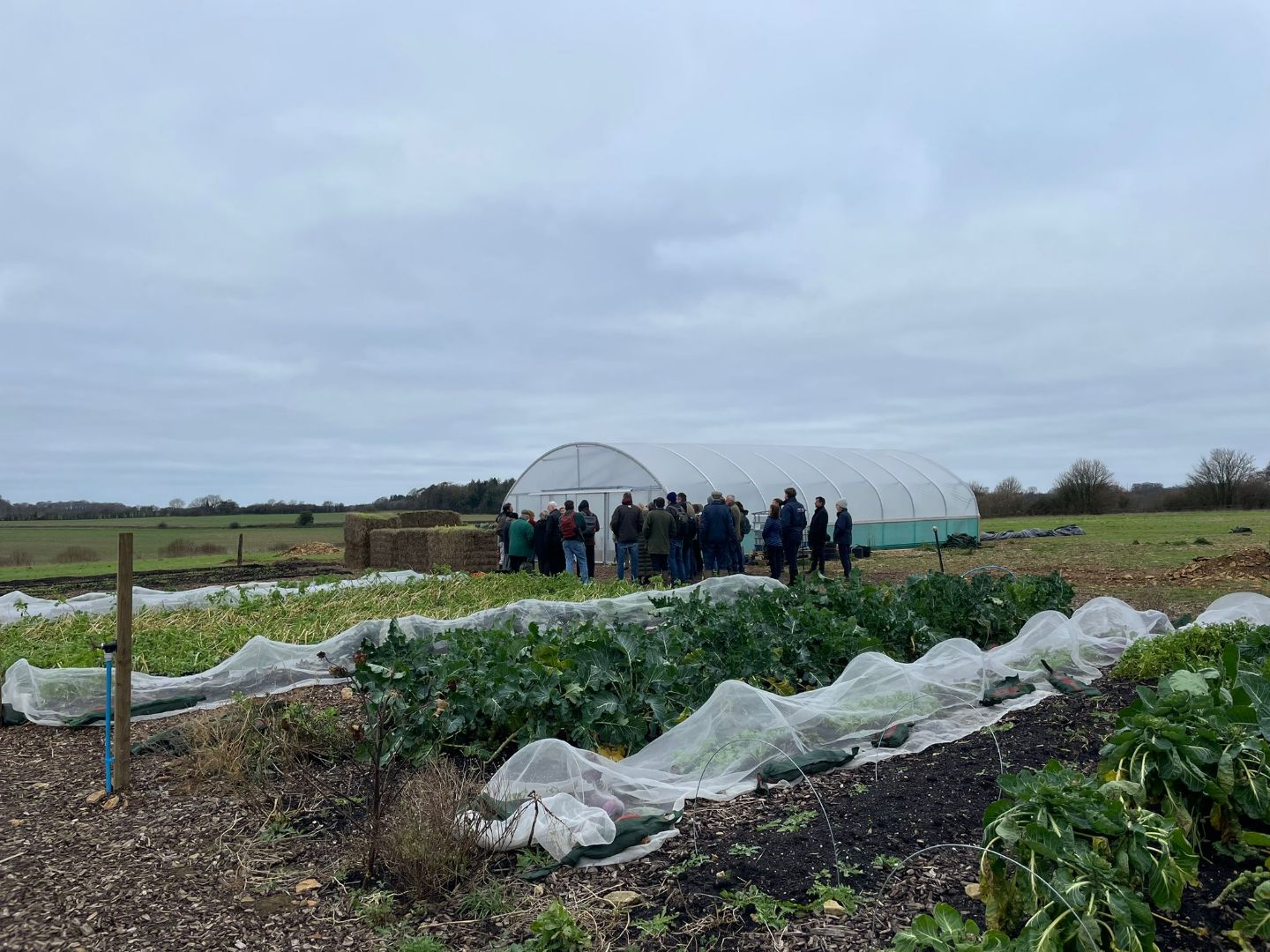
Innovation for Agriculture’s event on water catchment management and sustainable farming was held at the Royal Agricultural University in December 2024. The event brought together farmers, policymakers, researchers, and industry professionals to explore the intersection of farming and water management.
The event included a site visit to the GREAT Zerodig Project, and talks and discussions on landscape scale collaboration, agriculture’s water consumption, catchment management in practice and slurry and water management in winter months.
Zero Dig Project
The event began with a visit to the GREAT Zerodig Project, a hands-on initiative focused on growing a diverse range of nutritionally dense vegetables. These crops are cultivated not only for use in on-campus catering but also with the potential to support local businesses and benefit the wider community. The project is designed to make the most of campus resources, such as wood chips from felled trees, which are spread across the fields to enhance soil health. This method brings several environmental benefits, including improved soil structure, better infiltration of surface water for effective flood management, and fostering a diverse fungal population that boosts soil biodiversity. Additionally, the project serves as a valuable learning tool for students, offering them a unique opportunity to engage with sustainable farming practices while tying their academic studies to real-world applications. Find out more in this case study video.
Collaboration across landscapes
Jenny Phelps from FWAG spoke about the importance of collaboration across landscapes. She made the compelling point that a single farmer striving for sustainability in isolation will have little impact. To make a significant difference, it is essential to foster collaboration across regions and identify areas where interconnectivity can enhance sustainability. Jenny proposed that local authorities could play a more effective role in water and catchment management by first mapping landscapes to identify opportunities for improvement. She also suggested innovative solutions such as pyrolysing human waste into biochar, which could then be spread on fields to both repurpose waste and enhance soil health.
Agriculture’s water consumption
Kiran Tota-Maharaj from the Royal Agricultural University (RAU) highlighted the pressing issue of agriculture’s water consumption, which accounts for 70% of the world’s fresh water usage. He discussed the importance of considering the water-energy-food nexus—examining how agricultural waste can be integrated with energy production waste and vice versa to build more sustainable and resilient systems. Kiran also outlined the challenges of reusing wastewater, noting that while there is significant potential, removing chemical and pharmaceutical pollutants to meet regulatory standards is a major hurdle. To tackle these challenges, RAU students are involved in several innovative projects, such as creating constructed wetlands using biochar to generate electricity and exploring precision irrigation for wastewater reuse in collaboration with the Trinidad and Tobago Government. Another promising project is Plasma Activated Water (PAW), a technique that uses plasma treatment to eliminate pathogenic microbes in agricultural wastewater.
Using AD to process poultry manure
Aubrey Green from Herefordshire Biogas shared insights into the operation of their anaerobic digestion (AD) plant, which began in 2018. Powered by poultry manure and maize, the AD plant now provides energy to a neighbouring insulation company and plans to expand its capacity. While feedstock prices have risen significantly, Aubrey remains optimistic about working with more local suppliers to stabilise costs. He also addressed the issue of rock phosphate supply, which is expected to last only around 100 years. Alternative sources like digestate from poultry manure could help mitigate this issue, reducing dependency on imports and enhancing supply chain resilience. The company is also experimenting with feedstock ratios to produce wastewater that complies with environmental regulations, potentially making it suitable for irrigation. This work is part of a broader effort to support farmers in managing poultry manure without increasing phosphate levels in the final digestate, thus preventing runoff and ensuring compliance with environmental standards.
Agriculture and wider policy
Cllr Matthew Riddle highlighted the growing connection between agriculture and broader government policies, such as the Public Goods Act and Environmental Land Management Schemes (ELMS). He shared a case study of Pool Brook, a waterway affected by tidal fluctuations from the River Severn. The brook often becomes dark brown during flooding, indicating the loss of soil from surrounding fields. Working in collaboration with a local farmer, the local council implemented strategies to reduce flood risk. These included building leaky dams to retain water in low-lying fields and adopting more sustainable field management practices, such as planting spring crops, using cover crops in winter, and shifting to a no-till system to improve soil health. This case study underscored the importance of collaboration between farmers, councils, and environmental groups in tackling flood risk and improving soil management.
Catchment management in practice
The panel discussion, chaired by Paul Westaway, featured several speakers who shared their experiences with catchment management in practice.
Jonty Brunyee from Conygree Farm discussed the importance of embracing disruption and adapting farming practices to improve sustainability. Through rotational grazing and a focus on biodiversity, Jonty has found that many of his practices are already benefiting water quality and flood management, even though he hadn’t initially considered water management a priority. Jonty also encouraged collaborative, bottom-up initiatives like local farm cluster groups for knowledge exchange and mutual support.
Rosie Nelson from Thames Water emphasised their evidence-based approach to flood and pollution management. She explained how Thames Water is working towards a more holistic, catchment-wide strategy that integrates natural flood management, farm management changes, and biodiversity conservation. By collaborating with other stakeholders and engaging in citizen science projects, Thames Water aims to develop long-term, sustainable solutions.
Andy Rumming, who farms a beef suckler herd, turkeys, and sheep, shared his experience of dealing with floods from the Thames. By managing species-rich grasslands and collaborating with the Wildlife Trust, Andy has been able to create a productive, biodiverse farming system. However, he faces challenges in housing cattle during increasingly mild winters and is exploring seasonal grazing to manage his herds more effectively.
Managing slurry and water during winter months
Finally, Robert Iles from the Environment Agency provided practical advice on managing slurry and water during the winter months. He discussed the key points of the 'Winter Ready' campaign, which encourages farmers to assess their slurry storage capacity, develop contingency plans for wet weather, and ensure that clean and contaminated water are separated. He also introduced the AHDB Slurry Wizard, a tool that helps farmers calculate their slurry storage needs. Robert highlighted recent regulatory changes, including restrictions on when and where slurry can be spread, ensuring that it aligns with crop needs and environmental protection standards.
Conclusion
The discussions at the event highlighted the importance of adaptive management, policy integration, and local collaboration in tackling water quality issues and improving agricultural practices. It was a reminder that, by working together, we can create more resilient, sustainable systems that benefit both the environment and the farming community. Hear more about what attendees from the event had to say here.
By Catherine Carlton