
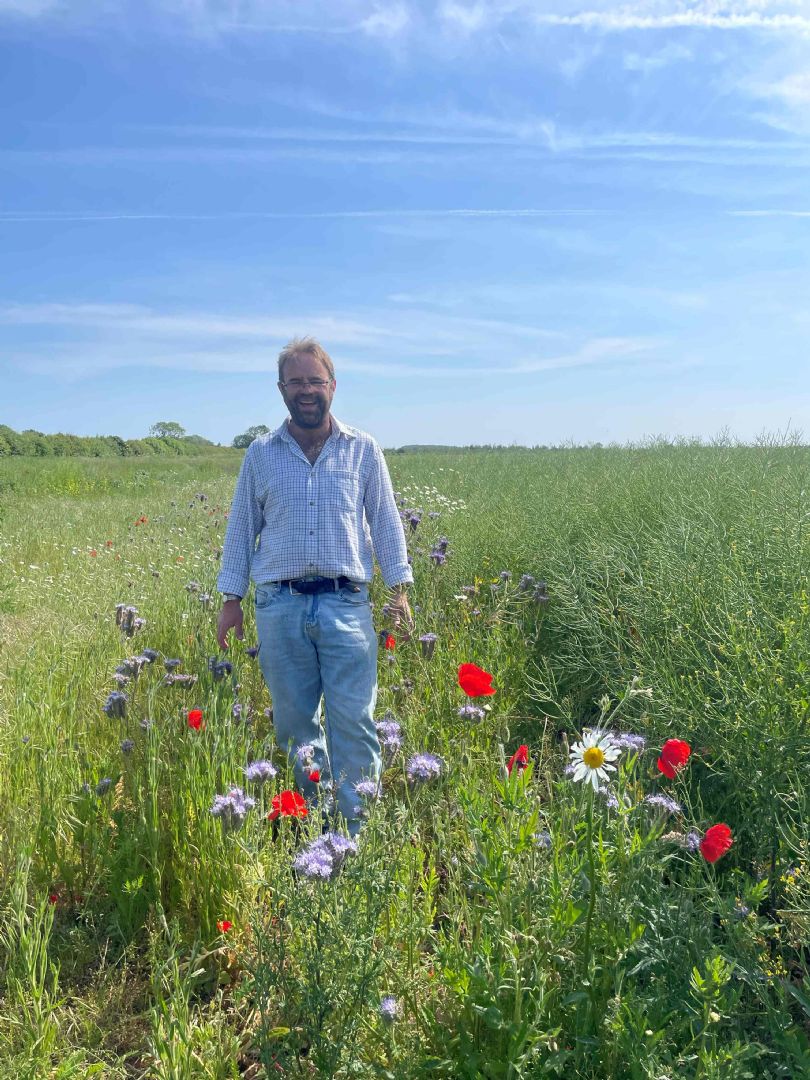
Colin Chappell manages an arable farm in Lincolnshire where he grows winter barley, winter wheat, oilseed rape, spring peas, winter beans, spring barley, spring oats and miscanthus. He also incorporates grass and legume fallows which are grazed by sheep managed by a local shepherdess.
With heavy clay loam soils which are prone to be flooded by the river Ancholme, Colin has taken remarkable steps to improve soil health and by doing so, increase his farm’s resilience to flooding events. It was these changes that earned him third place in the 2026 Soil Farmer of the Year competition.
Farm flooding events
Colin’s father was flooded once in his entire tenure at the farm, however after Colin took over in 1997 there was a dramatic uptick in flooding events, with flooding in 2001, 2007, 2008, 2009, 2012, 2016, 2017, 2018, 2019, 2023, 2024, 2025 and 2026.
The New River Ancholme flows along the farm boundary. This is an artificial, straight cut channel that was originally built for drainage and water abstraction purposes. The levels which the New River Ancholme should be kept at were decided in the 1800s and have not been reviewed since, and the river has had no maintenance since 1970.
Colin explains that since he began farming the overall amount of rain has increased by a modest amount of 20mls per year, but there is now a boom or bust pattern to rainfall events with 30-50mls at once and long dry periods.
“Rainfall events with over 50mls cause the river to overtop, but because of the lack of maintenance, the water comes through the riverbank and floods the fields even before the river itself overtops,” says Colin. “In a nutshell, I have to suck it up and deal with whatever climate change throws at us.”
Using reduced cultivations to adapt to flooding
In 2017 Colin’s farm became an AHDB monitor farm and he was given the challenge to stop cultivations using the plough and power harrow, and to vastly reduce soil disturbance. The aim was create a sponge-like soil that would absorb large quantities of rainfall and allow plants to access held water throughout dry periods.
Colin took the leap and ‘went cold turkey’ by transitioning straight to using a disc drill in one 8.5ha field. The immediate results were not promising, as he effectively created a channel motorway for slugs and the seeds ended up sat in water, leading to poor establishment.
From 2018 to 2022 Colin stuck with the direct drilling, primarily because he was in a peer environment where they were monitoring what was happening. During that period Colin was getting half the yield, but at the end had transformed the soil and had achieved the sponge-like properties he was aiming for.
“At the time I had subsidies and environmental measures in place that meant financially I could stick with it, but it wouldn’t be possible for every farm to do it like that,” he says.
Since 2022 Colin has tried cultivating at different depths across the whole farm, with different drills and cultivators. He also now has a low disturbance subsoiler which he uses to counter any challenges such as compaction following flooding. When he uses this, he simultaneously ‘apologises’ to the soil, by applying a mix of potassium humate, fish hydrolysate and molasses to feed the microbes.
While Colin is pleased with how his soils have developed and become more resilient across the farm, the flooding can still have a significant impact. He shares that 2026 looked really good until the farm received 30mls of rain on March 12th.
“The plants had all started to establish and the rain event hampered them, leaving gaps in the fields and affecting root establishment, which caused issues later during the summer drought,” he says.
“Ultimately the minimum soil disturbance helps up to a point, but it depends on the weather events in any given year.”
That said, still achieved an average of 8 tonnes per hectare across the farm in 2026, which has been a challenging year across the UK.
Keeping soil covered
Another change which Colin has implemented across the farm has been to keep the soil covered wherever possible.
When his crops were harvested in July 2026 he still had cover across approximately half of the farm, which included grass, environmental measures or miscanthus.
“Covering the soil was powerful this summer, as when we were getting those days of over 30°C heat, the difference in soil temperature between bare soil and covered was as much as 10 degrees”, says Colin. “This mitigates the impact of the drought and the punishing effect of the heat on the microbes in the soil.”
Having cover crops in place also helps when the farmland floods, but it does depend on the quantity of rainfall and how long it stands on the land for.
“It has got better over the years. I’m losing bits of fields now, whereas a few years ago I lost 85% of the crops on the farm,” says Colin. “That’s because the soil is absorbing a vast amount.”
He is still seeing the ponding effects, but the land is recovering faster, meaning Colin can get back on the land within a week to 10 days, vs two to three weeks previously.
The power of functioning biology
From 2018 to 2026, Colin expanded the size of the farm by approximately a third when he took on some neighbouring land which was classified as ‘degraded’.
He shares that it was the biological processes that were not working, as it was a bacterial dominant soil with lots of blackgrass. He took advice from soil expert Ian Robertson, who used the analogy of having everything locked up in the fridge, and just needed to unlock it.
When he took it on, the land had a phosphate index of 0.3, which was a result of continuous extraction without replenishing the soil with any organic matter for many years.
Ian Robertson advised putting gypsum on the soil to balance the calcium to magnesium ratio, which in turn supported phosphate availability. They also concentrated on ensuring there were always living roots in the soil, which release root exudates, feeding the microbes and helping the soil biology to function.
“It didn’t really matter if it was a big crop of forage barley or a big overwintered cover crop, but we focused on having natural rooting and enabling earthworms to do their job, which helped water percolate through,” says Colin.
Having brought the phosphate index up to 0.5 by the time he handed the land back to his neighbour, Colin was yielding 10 tonnes/hectare milling wheat and 38.5 tonnes/hectare forage barley from the land.
“I could get a higher yield off that field than people can with a phosphate index of three or four, all it took was unlocking the door and enabling the biological processes to function,” says Colin.
Fuel and cost savings
Reducing cultivations has meant that while Colin has expanded the farm by a third, he is still using the same quantity of fuel that he was prior to 2018. The combine, low disturbance subsoiler and the drills all use approximately nine litres per hectare.
In addition, the fact he’s no longer applying fungicides and has improved nitrogen use efficiency, which has also helped reduced fuel use and other input costs.
Enhancing nitrogen use efficiency
Reducing cultivations, keeping the soil covered and maintaining living roots in the soil has contributed to transitioning from a bacterial to a fungal dominated soil. In turn, this has meant Colin has had the opportunity to start reducing nitrogen inputs with little impact on yield.
Since 2022, he has reduced nitrogen inputs by approximately a third. He now uses liquid UAM, which provides three sources of nitrogen in one go, along with a dose of molasses.
The reason for this is the carbon in the molasses feeds the microbes in the soil, which enables them to process the nitrogen quicker, increasing the efficiency of nitrogen use and ultimately reducing the amount required.
Although he set out with the goal to improve soil structure to increase the resilience of the farm business to increasingly regular flooding events, the impact of reduced tillage and cover cropping across Colin’s farm has been far reaching, enabling him to reduce inputs without compromising yield.
Colin will be leading a Soil Farmer of the Year farm walk in 2027, where it’ll be possible to hear directly from Colin about his farming practices and the impact the changes he’s made. Details of this event will be shared via the Innovation for Agriculture and Farm Carbon Toolkit websites.