
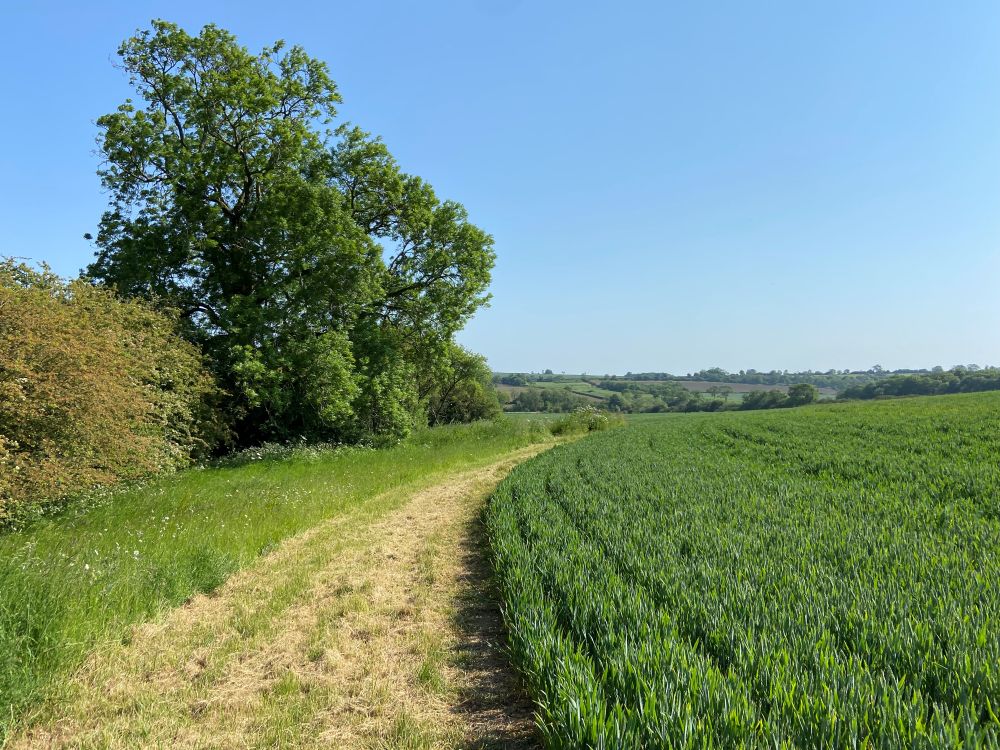
The Allerton Project is a working commercial and research and development farm. Its farm site, Loddington Farm, sits in a steeply rolling clay landscape with significant risk factors for arable cropping which can impact the quality of water leaving the farm.
The farm was highly commended in the 2026 Water Quality Farmer of the Year competition, due to its solid foundations in water quality protection, as well as its role in pioneering capital items and nature-based solutions, and sharing results with the farming community.
Water quality risks
The Allerton Project is in the Eyebrooke Reservoir catchment. Watercourses running through the farm feed into the reservoir, which has a long history of issues with sedimentation, dating back to the conversion of the mostly pastoral landscape to a mostly arable landscape from the mid-20th century.
Head of Sustainable Farming Joe Stanley explains that although clay does not erode easily, when it does erode, it is difficult to stop the soil from moving. “Prevention of soil movement, nutrient loss and pesticide run-off has been a focus within Allerton’s farm management for over 35 years,” he says.
In field practices to protect water quality
Joe stressed the importance of focusing on what happens in the field first, before investing in more drastic measures to protect water quality. Practices to support this at Allerton include reduced cultivations, keeping the soil covered, tramline management and agroforestry.
Cultivations
Joe shares that up until the late 1990’s Allerton was a plough-based arable rotation. “It has been a slow transition towards minimum tillage, but in the last ten years or so we have been predominantly direct drilling,” he says.
Compaction is managed using a low disturbance subsoiler. With the heavy clay soils, compaction is a big issue and can lead to increased water run-off, taking nutrients or pesticides with it into watercourses.
Keeping the soil covered
When a field is going to be used to grow a spring crop, cover crops are direct drilled immediately after combining the preceding crop to ensure soil is covered over winter.
With autumn sown crops, companion crops are increasingly being grown with them over winter, providing benefits such as repelling pests as part of the Integrated Pest Management (IPM) strategy or fixing nitrogen to enhance soil fertility.
Additionally straw residues are returned to the field. “Even if there’s no cover crop, straw residues help protect the soil surface from erosion,” says Joe.
Tramline management
Joe shares that as much as 80% of run-off at Loddington comes from the 2% of the field that is the tramline. This has meant focusing on managing tramlines has had a big impact on reducing run-off.
Management has included contouring around slopes instead of driving up and down them and disrupting tramlines with a tine. However, the most effective and practical thing has been using ultra low ground pressure tyres, which spread the weight of machinery as much as possible and have reduced run-off from tramlines by 70%.
“Ultra low ground pressure tyres are a much more practical option than disrupting all tramlines with a tine, and relatively low cost,” says Joe.
Agroforestry
The farm has also undertaken an agroforestry trial, dedicating a field to a silvopasture agroforestry system with trees planted at varying densities. As part of the trial, water infiltration measurements are being taken. These are expected to improve as soil structure improves, with potential benefits for water quality.
Integrated Pest Management
As part of the farm’s IPM strategy, larger fields are divided by beetle banks to provide habitat for predatory insects and enable them to venture into the crop to control insect pests such as aphids. The beetle banks also act as in-field buffers for runoff, providing an additional benefit for water quality.
Field edge interventions to protect water quality
While water protection starts in the field, larger fields at The Allerton Project are all surrounded by conservation margins. These play a role in IPM by providing habitat for beneficial crop pest predators, helping reduce requirement for pesticides. Again, there is an added benefit as the conservation margins act as buffer strips for spray drift and field runoff.
Building wetlands and installing capital items to improve water quality
Joe describes interventions like building wetlands or installation of capital items such as bunded ditches or sediment traps as “The last line of defence” in terms of water quality protection.
Wetland creation
The Allerton Project has created wetlands at appropriate places around the farm, which are effective at reducing pollution coming off the field. They are positioned along the Eyebrooke stream at the base of the sloping fields. Also in these fields, old field drains have been broken and pond scrapes created, which work together with the wetland to slow water down on its way to the stream, enabling sediment to drop out.
But Joe highlights that to sacrifice 60 to 80m around the edge of a field to benefit water quality you must either have a very good funding mechanism in place, or be very passionate about protecting your water quality. “Ultimately there needs to be a funding mechanism to enable farmers to go to more extreme lengths to protect water quality, as wetlands go way beyond regulatory compliance and sacrifice a lot of what could be productive land,” he says.
Installation of capital items
The bunded ditches and sediment traps in place at The Allerton Project were installed as research projects, proving the case for the items to be used elsewhere.
The bunded ditches have been installed in situations where there is a more pronounced slope down a field. They can enable effective drainage at the same time as holding some water back temporarily, which allows sediment to drop out and settle in the bunded ditch. They also provide a water source for wildlife in the predominantly arable landscape.
The sediment traps were placed at the end of field ditches, to catch sediment just before it leaves the farm. Joe explains that the sediment traps do not work well with clay soils due to the small particle size, but are effective elsewhere for farms with coarser grained sandy or loamy soils. The research project which tested sediment traps included three farms with different soil types. Over two winters following sediment trap installation, just 200kg sediment was collected at the Allerton Project, verses 20 tonnes at the loamy site and 40 tonnes at the sandy site.
“The sediment traps demonstrate very different efficacy depending on soil type, so it is really important to understand the context that these items work in and select the one right for your farm,” says Joe.
“Here, the most important thing that can be done for water quality is to stop the soil moving in the first place.”
About the Water Quality Farmer of the Year Award
The Water Quality Farmer of the Year Award celebrates the practical work already taking place on productive commercial farms to protect and enhance water quality.
The competition recognises farmers and farm managers who are delivering positive outcomes for water through practical action, whether through nutrient management, runoff reduction, more targeted input use, improved livestock management, soil structure improvement, or wider catchment-based approaches.
Delivered by Innovation for Agriculture, the award is supported by Portsmouth Water, Wessex Water, Southern Water, Severn Trent Water and Anglian Water.