
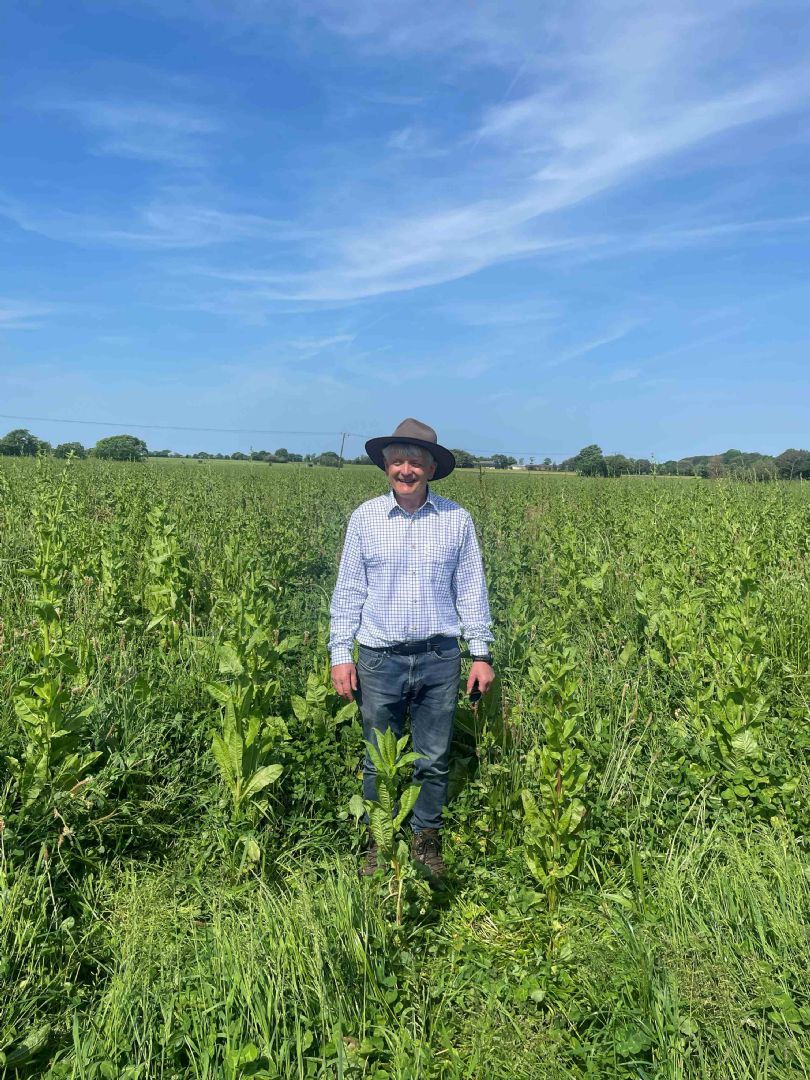
Chris Molyneux, winner of the 2026 Soil Farmer of the Year competition, is a specialist kale grower whose career is marked by a willingness to experiment, trial new crops and test different approaches to improving soil structure.
In this case study we share insight into Chris’s farm management, including the rotation, nutrient management, development of own varieties and the impact of improving soil on the farm business.
About Molyneux Kale Company
Based in Lancashire, Chris grows approximately 350 acres of kale each year, including pink kale, red kale, Cavolo Nero, Siberian kale and variegated kale. He also grows chard, spring greens, Italian chicory, monk’s beard and kohl rabi. His business, Molyneux Kale Company, supplies food-service outlets, wholesale markets and Booths, a premium supermarket in north-west England.
The farm has been in Chris’s family since the mid-1850s. It was originally a mixed farm growing potatoes and cereals and rearing cattle. Over time, the business became more specialised, with Chris’s father focusing on vegetables and cereals.
The farm first grew kale in the late 1980s, when supermarkets struggled to source parsley for decorating their fish counters. The family began supplying frilly kale for this purpose, years before it became popular as a vegetable in its own right in the UK.
They later began supplying kale to the Netherlands, where demand rises sharply during frosty weather, much as it does for Brussels sprouts in the UK. This helped shape Chris’s decision to specialise in kale when he began farming independently. He renamed the business in 2013 and expanded the area under cultivation from 50 acres to the 350 acres grown by Molyneux Kale Company today.
A shifting perspective on soil
As Chris’s knowledge of kale has grown, so has his understanding of soil. After graduating with an agriculture degree from the University of Reading, he spent time working on farms in Australia.
Chris recalls Australian farmers describing the use of a mobile plough as ‘so 19th Century’, reflecting how long they had been reducing soil disturbance during cultivation. He could see the logic in this approach and, on returning to farm with his father and uncle, began questioning whether there was another way of doing things.
The soil on the farm is a shallow sandy loam, which has up to two feet of topsoil, then either clay or sand beneath. It is in a high rainfall region, which gets about 950ml per year, which has been increasing on average since they began recording rainfall from 1986. Typically, they were ploughing in the autumn then struggling to establish crops in wet, mushy ground until it dried out and the plants got going in the spring.
After returning to the UK, Chris experimented with minimum tillage (min-till). He found that reducing soil disturbance allowed the surface to weather, making it possible to prepare a good seedbed with less cultivation. He also tried subsoiling followed by a power harrow finding that cabbage, kale and other brassicas could be planted without ploughing.
Next he tried strip tillage. “People thought I was mad, but it even worked on soils that were a bit degraded,” he says. “I could strip till directly into a stubble and found that once the crops got going, they didn’t need as much tilth as everyone thought.
“They were growing well unless there was damage in the subsoil, in which case we did need to do some remedial activity,” he adds.
Chris observed that with less soil movement, they were seeing worm activity increase. The soil was becoming more biologically active, with more bacterial and fungal activity, which further increased with the use of cover cropping.
Using cover crops
With such a specialised business, Chris no longer uses a traditional rotation and instead grows a cover crop for three years, followed by three years of cropping kale and other field vegetables.
To increase nitrogen levels in the soil, he chooses cover crop mixes that include a high proportion of legumes. When he is ready to put a crop in, he uses glyphosate ahead of any cultivation to reduce competition from the cover crop and enable the cash crop to establish.
Typically, the clover regrows and competes with the crop, so he uses clopyralid to suppress it and enable the crop to dominate. Some clover usually remains at ground level, allowing it to regrow after harvest and continue fixing nitrogen.
Soil management on rented land
On his rented land, Chris follows the same principles on a shortened timescale. He aims to take on new land in the autumn as stubble, which enables him to put a cover crop in over winter, such as a rye and vetch mix.
One challenge with autumn-sown cover crops is establishing them early enough to maximise soil cover and encourage biological activity.
“The limitation on growing autumn sown cover crops in the north of England is the amount of daylight hours,” he says. “From September they tend to develop slowly from one growth stage to the next and it is due to the reduced sunlight compared to establishing them earlier.”
He shares that the trick with cover crops is to choose based on the size of the seed. “A larger seed will give a lot of leaf cover quickly, so the plants have a chance to photosynthesise, grow and provide more cover,” he says.
“It’s why vetch grows well. But even with vetch it will come up, produce a few leaves and then just sit there, as it runs out of energy and needs more sunlight hours in the spring to get going again.”
If he can access rented land earlier, Chris establishes a clover cover crop in August, choosing crimson clover because it has a relatively large seed.
With a clover cover crop on rented land Chris cuts it and strip tills into it in the spring. With a rye and vetch he uses a herbicide, tops it off and then prepares the ground using strip tillage. Either way, the aim is to increase biological activity in the soil ahead of the crop.
Nutrient management
Chris explains that cover crops can create uneven nitrogen availability across a field because legume species are not always distributed evenly within the mix. To address this, he harvests cover crops and applies the material to another field growing a cash crop. He then tests the material to establish the quantities of protein, dry matter, nitrogen, phosphate and potash it contributes.
For each cash crop, Chris tests the soil to understand nutrient requirements for the crop. He only adds the quantity and type of fertiliser that is required, depending on the outcome of the soil testing.
Sometimes the preceding cover crop and application of a harvested cover crop are sufficient to meet the nutritional requirements of the crop. In 2026 Chris had three fields where very little fertiliser was required, including a chard crop which did not need anything as the N, P and K levels were all good. Chris pays particular attention to nitrogen, using advanced testing with Hillcourt Research and Farmacy to assess requirements.
“Excess nitrogen creates a ‘soft crop’ that is susceptible to disease and abiotic stress, like drought or frost,” he says.
Impacts of improved soil
As well as being able to reduce fertiliser applications, reduced soil movement and increased biological activity has resulted in the soil becoming much more friable.
Chris credits the way he manages his soil with being the reason he can grow the acreage he does. “I’m less limited by time-consuming cultivations that have to take place during a short window of opportunity when the soil is try enough to work it,” he says.
“The improved soil structure carries machines better, and there have been a lot of wet periods when the increased friability of the soil has meant I can get back on it and get crops in earlier than I would otherwise.”
He also reflects that strip tilling works well in dry conditions such as the spring of 2026. “With strip tillage, because we’re only moving the part of the soil we’re going to plant into, we release less moisture from the cultivations,” he says.
Developing own varieties
Chris’s family has a long history on the farm, which has included saving seed and the development of a unique variety of spring greens, which they have named heritage greens, as it has existed for generations. The heritage greens fit the local climate perfectly and provide a crop much earlier in spring than any of the standard spring green varieties.
The family’s approach to seed selection has also shaped its kale production. In one year, cross-pollination occurred between kale and spring greens. Chris noticed that some of the resulting kale plants did not bolt in spring, so he saved their seed. Over the following decade, he developed a kale variety that resists spring bolting.
Chris is now selecting kale varieties to extend the growing season and supply buyers at times of year when they would otherwise source produce from abroad. For example, he has developed a Cavolo Nero variety that can be harvested from January to June, when supplies would otherwise come from Spain and Italy.
With several varieties, Chris is taking a similar approach to extending the season, while also selecting for other desirable traits. “Because there’s wide variety of genetics in open pollinated varieties of brassicas, there’s potential to select for things quite quickly, such as resistance to a particular disease or to dry weather,” he says.
Chris regards variety selection as a key contributor to the farm’s success. “By following regenerative agriculture principles it’s possible to improve margins by reducing the need for chemistry, but by selecting plants that do well in our soil and climate, I believe that’s behind our ability to increase yield too,” he says.
A key element of the Soil Farmer of the Year competition is the diverse opportunities to learn from the winners’ experiences and how they have implemented soil management practices in their businesses. To hear more from Chris, come to his Soil Farmer of the Year farm walk on Wednesday 25th November, 2026.