
By Iory Hughes, livestock projects assistant at Innovation for Agriculture
Biometric sensors and monitoring devices are used on UK farms to track livestock behaviour, stress levels and overall welfare. Here we explore how biometric sensors can promote herd health, as well as the other benefits and current limitations to adoption of these technologies.
What are biometrics?
Biometrics are technologies that measure physical characteristics. Temperature, movement, rumination, heart rate, respiration rate and water intake can all be measured to give insight into the current state of the animal. Any parameters which are outside of the ordinary indicate a change in health status. Biometrics could become a key asset in maximising the productivity and health of animals as advancing technologies are incorporated into livestock systems.
Benefits of biometrics
Biometrics can detect changes in an animals’ condition giving early warnings for farmers to make informed management decisions. These include:
- Early disease detection - Measuring a change in eating habits, temperature or activity can indicate the presence of a disease. For example, by using Smaxtec to monitor temperature, farmers can detect a mastitis infection early and use an anti-inflammatory to support the cow in managing the infection without the need for antibiotics.
- Labour efficiency - With many in the agricultural sector struggling to attract staff, biometrics provide information on which animals require attention, allowing workers to focus on urgent tasks.
- Improving reproductive management - Biometric systems assist with identifying oestrus (heat), with monitors measuring mounting behaviour and movement. This case study from CowManager demonstrates how using biometric tags in a dairy herd can increase conception at first service by 40%, due to the optimum window for service being identified.
- Optimised nutrition and performance - With constant monitoring of body condition and mobility, technology such as Herdvision detects subtle changes, which allows informed decisions to be made about required dietary changes or early treatment of lameness.
- Use of technology in farm assurance schemes - Biometric analysis of animal condition can be used as non-biased evidence of a farm’s performance and to demonstrate a high welfare production system.
#Toniontours biometric technology
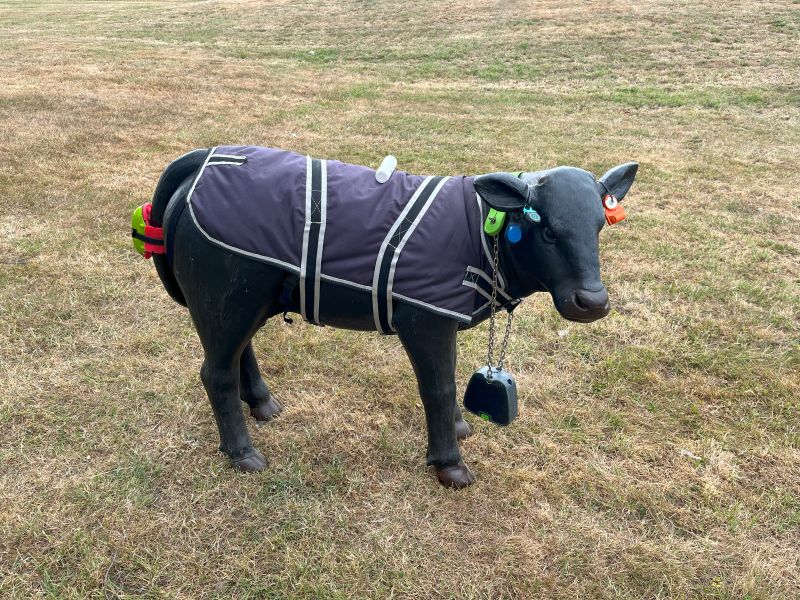
During Innovation for Agricultures’ summer events, #Toniontour, our legendry plastic cow, raised awareness of what biometric technology can provide for farmers. Toni has biometric tags from CowManager, MSD, and Well Calf, all constantly monitoring the calf or cow. Additionally, Smaxtec provided a bolus which sits in the reticulum of a cow measuring internal body temperature, water intake and even pH for optimisation of the animals’ ration. To complete the set, we added Moocall to Tonis’ tail which measures tail movements indicating contractions, warning of imminent calving. Using automated monitoring cameras such as Herdvision allow farms to monitor cow health and productivity through recording the mobility and body condition score of animals.
Limitations to adoption of biometric technologies
Data ownership and privacy
An article in the ‘Frontiers in Sustainable Food Systems’ journal in 2022 acknowledged farmers are concerned about the privacy of their data when precision technologies are collecting large amounts of data related to a farm. It was recommended that agricultural technology providers are key in solving the issue and must build trust with farmers, request consent before sharing data and clearly outline where data will be shared.
High initial costs
Initial installation of biometrics can be expensive, with immediate return on investment not always seen. Research into whether investing in biometrics is worthwhile reports that using these technologies is profitable in the longer term. Although there is a lack of research in this area, especially in the UK, a study from 2020 reviewing the economic viability of automated oestrus detection technologies supported the adoption of data supporting technology. Other biometric technology is predicted to have similar reports. The use of grants can also be invaluable when adopting this technology. The recent Farming Equipment and Technology fund in England supported technology benefiting animal health and welfare, and trials of new biometric systems can currently be funded through the ADOPT fund.
Poor connectivity
An NFU survey in 2024 found 76% report some level of unreliable mobile signal on farm with 42% reporting inadequate broadband speeds for the needs of their business. Real-time biometric alerts from systems such as CowManager or Allflex may therefore be missed delaying treatment of an animal health issue. Investment in internet connectivity would be essential to facilitate the use of biometrics.
Lack of digital skills
Innovate UK identified a lack of training as one of the key reasons holding back the adoption of AgriTech, as a farming community with an average age of 59 seeks to improve digital literacy. The challenge for the companies providing biometric technology is to develop systems that are easy to use and provide the support farmers require.
Future of biometric technology on livestock farms
Biometric technology is set to become mainstream on UK livestock farms. As the technology continues to improve and is coupled with ever evolving farm management software the systems can become an invaluable asset benefitting animal welfare and farm profitability. A range of factors provide challenges for the adoption of biometrics, but as internet connectivity and confidence in the security of farm data increases and the cost of the technology decreases, future widespread adoption of biometric technology appears to be inevitable and can be expected to be highly beneficial.